
Amazon S3 Vectors - Cost-Optimized Vector Storage for AI
Explore how Amazon S3 Vectors revolutionizes vector storage and querying, reducing costs by up to 90% with native support for AI agents, semantic search, and RAG at scale.

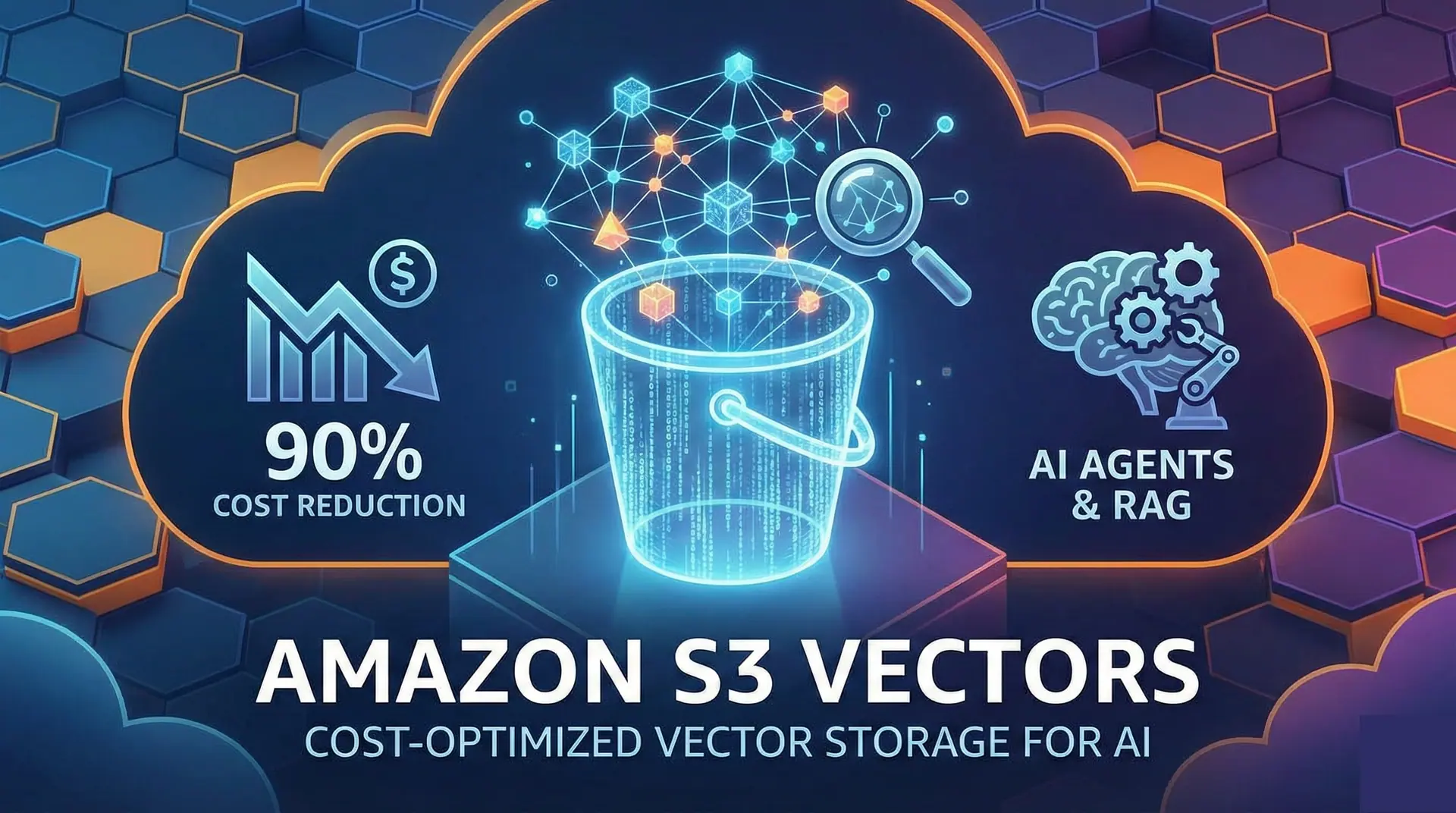
2025 marks a critical turning point in cloud storage when AWS launches Amazon S3 Vectors - the first cloud object storage service with native support for vector storage. This represents a major breakthrough for organizations building large-scale AI applications. Let's explore how S3 Vectors transforms the way we store, manage, and query vector data.
What is S3 Vectors?
Amazon S3 Vectors is a cloud object storage service optimized for efficiently storing and querying vector embeddings. Unlike traditional vector database solutions, S3 Vectors is built on the proven foundation of Amazon S3, combining its flexibility, durability, and scalability with native vector search capabilities.
Key Features
- 90% Cost Reduction: S3 Vectors reduces storage, upload, and query costs compared to dedicated vector databases
- Massive Scale: Support for up to 2 billion vectors per index, up to 20 trillion vectors per bucket
- Fast Performance: Warm query latency of just 100ms, fast enough for most applications
- Native Integration: Seamless integration with Amazon Bedrock Knowledge Bases and OpenSearch
Why S3 Vectors Matters
1. Cost-Effective for Large Vector Datasets
Before S3 Vectors, organizations had to choose between:
- Dedicated vector databases: High performance but expensive
- Self-hosted solutions: Cheaper but requires complex infrastructure management
S3 Vectors provides a third option: combining S3's power (at just $0.023 per GB) with intelligent vector query capabilities.
2. Perfect Integration with AWS AI Ecosystem
- With Amazon Bedrock: Economically store vector embeddings from Knowledge Bases
- With OpenSearch: Implement tiered storage strategy - keep cold vectors in S3, activate hot data in OpenSearch
- With SageMaker: Direct integration for building Retrieval Augmented Generation (RAG) pipelines
3. S3's Elasticity and Durability
- 99.999999999% (11 nines) data durability
- Automatic scaling without configuration
- No capacity planning concerns
Real-World Use Cases
Use Case 1: Semantic Search for Media Archives
Scenario: A television company with millions of hours of video needs rapid search.
S3 Vectors Solution:
- Convert each video frame into vector embeddings
- Store billions of vectors in S3 Vectors
- Search for similar scenes based on content in under 1 second
Result: 90% cost reduction vs. traditional vector databases, faster search
Use Case 2: Retrieval Augmented Generation (RAG)
Scenario: An AI startup wants to build intelligent LLM apps that answer questions based on proprietary knowledge.
S3 Vectors Solution:
Standard RAG Flow:
1. Convert documents to vector embeddings (using Bedrock)
2. Store vectors in S3 Vectors
3. When user asks, convert query to vector
4. Search semantically in S3 Vectors
5. Retrieve relevant documents
6. Feed to LLM for response
Cost: 70-90% savings vs. dedicated vector database
Use Case 3: AI Agents with Long-term Memory
Scenario: Build intelligent AI agents that remember historical context.
S3 Vectors Solution:
- Store all conversations and past decisions as vectors
- Agents query S3 Vectors for relevant context
- Improve decision quality over time
Architecture and How It Works
Standard Architecture
┌─────────────────────────────────────────────────────┐
│              User Applications                      │
└──────────────────┬──────────────────────────────────┘
                   │
        ┌──────────┴──────────┐
        │                     │
┌───────▼────────┐   ┌───────▼────────┐
│  Amazon Bedrock│   │ OpenSearch     │
│  Knowledge Base│   │ (Hot Layer)    │
└───────┬────────┘   └───────┬────────┘
        │                    │
        └────────┬───────────┘
                 │
        ┌────────▼──────────┐
        │  S3 Vectors       │
        │  (Cold/Main Store)│
        │  - 2B vectors     │
        │  - Sub-sec latency│
        │  - 90% cost save  │
        └───────────────────┘
Simple API
# Store vectors
s3.put_object(
    Bucket='my-bucket',
    Key='my-index/vectors',
    Vector=[0.1, 0.2, 0.3, ...]
)

# Semantic search
results = s3.search_vector(
    Bucket='my-bucket',
    IndexName='my-index',
    Vector=[0.15, 0.25, 0.35, ...],
    TopK=10
)
Performance Metrics
| Metric | Value |
|---|---|
| Cost Savings | 90% vs Vector DB |
| Max vectors per index | 2 billion |
| Warm query latency | 100ms |
| Indexes per bucket | 10,000 |
| Max vectors per bucket | 20 trillion |
| Durability | 11 nines |
| Availability SLA | 99.99% |
Standard Deployment Strategy
Tiered Storage
Cold (S3 Vectors):
- Store entire vector corpus
- Low cost
- Latency 100-500ms
Hot (OpenSearch):
- Store frequently queried subset
- High performance (10-50ms)
- Higher cost
Benefit: 70% total cost reduction vs. storing everything in OpenSearch
Real Enterprise Customers
Squiz: Conversational Search
- Results: 50% processing speed increase, 60% cost reduction
- Improvement: Scale from 25K to millions of vectors per client
MIXI: Photo Sharing Platform
- Scale: 27 million users
- Plan: Index 400 million vectors
- Benefit: Intelligent photo search for all users
March Networks: Video Intelligence
- Application: Index millions of hours of video
- Improvement: Sub-second semantic search across entire archive
Cost Optimization
1. Use Tiered Storage Strategy
- Keep hot data in OpenSearch
- Store cold data in S3 Vectors
2. Optimize Vector Size
- Choose appropriate embedding model
- Balance accuracy vs. cost
3. Manage Lifecycle
- Delete old vectors
- Archive unused data
Known Limitations
- Latency: 100ms warm query - not suitable for real-time < 50ms
- Maturity: New product, still in development
- Vendor lock-in: Deep integration with AWS ecosystem
Conclusion
Amazon S3 Vectors represents a major shift in how we build large-scale AI systems. By combining:
- 💰 Low cost of S3
- 🚀 Massive scale (2 billion vectors)
- ⚡ Adequate performance (100ms latency)
- 🔗 Native integration with AI services
S3 Vectors solves the question "how to store vector embeddings cost-effectively at scale?" - a challenge hundreds of AI organizations face today.
If you're:
- Building RAG systems
- Deploying semantic search
- Developing AI agents with long-term memory
- Looking to reduce vector storage costs
Then S3 Vectors deserves serious consideration.